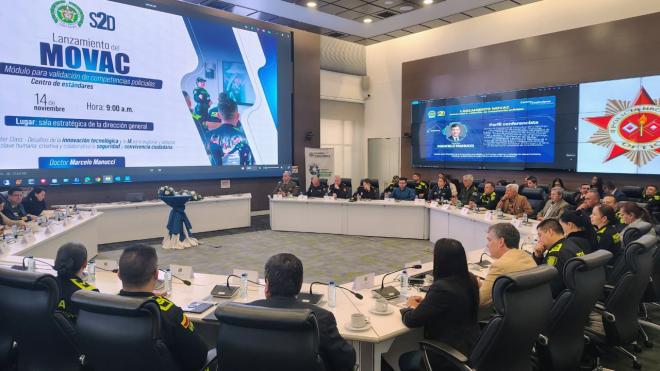
A police badge comes with authority, but it also comes with homework. In Colombia, the National Police put a new digital system into service to validate functional police skills. The goal is a more consistent and modern way to measure what officers know and what they can do in real situations.
The platform is called MOVAC. It was developed over one year by two uniformed members and delivered by the Office of Information and Communications Technologies to the National Police Standards Center in Bogotá.
What MOVAC is and why it matters
MOVAC centralizes the information used to validate police competencies, both theoretical and practical. Its design focuses on integrity, precision, and traceability, meaning records should be accurate and easy to audit later.
It also connects with Colombia’s effort to professionalize police careers. Law 2179 of 2021 strengthened professionalization and set rules tied to career development for uniformed personnel.
In plain English, MOVAC tries to make evaluations less messy. Instead of scattered forms and different local methods, the institution can run validation through one shared system.
A launch with a national tone
The rollout event in Bogotá brought together government officials, experts, and international police representatives. Vice Minister Olga Lucia Claros attended along with 11 police attachés and other institutions.
There were 80 in-person participants and another 160 connected virtually from police training schools across the country.
A master class led by Marcelo Manucci explored how technology and AI can shape security and citizen coexistence. The talk touched on strategy, ethics, and creativity in a world that keeps getting more digital.
A platform built to connect systems
MOVAC was created through Resolution 02200 dated August 1, 2025, and it was registered with Colombia’s National Copyright Directorate, known as the DNDA.
The platform includes interoperability features, meaning it can connect with other institutional systems once the relevant offices coordinate. That can reduce duplicate data entry and help decision makers work with the same information.
For a large public institution, interoperability is a big deal. When systems exchange data safely, teams can respond faster and cut down on manual errors.
What officers and citizens could notice with MOVAC
For police officers, a clearer validation system can mean clearer expectations. It can also support fairer comparisons, since the same standards are used across regions.
For citizens, the benefit is indirect but real. Stronger training checks can support more professional service, better accountability, and more transparent internal processes.
That does not mean a screen replaces judgment. It means the institution has better tools to prove who meets the standards and who needs more training.
The bigger career shift
Law 2179 of 2021 also links competency validation to advancement and education inside the police system.
MOVAC fits that direction by managing validation at scale, with audit-friendly records that can be reviewed when needed. It also supports the idea that skills should be measurable, not assumed.
Skills over paperwork
The real promise of MOVAC is simple, it should help ensure that a police title reflects real abilities, not just time served. If it works as intended, the platform can make validation more organized and easier to improve over time, as policing challenges keep evolving.
In the end, that is what modernization should look like, fewer loose papers, clearer standards, and better proof that the people wearing the uniform are ready for the job.
A practical detail also mattered. The National Police created MOVAC through a formal resolution in 2025, which means it is not just a pilot, it is part of the official institutional toolkit.
For Colombia, that kind of internal tech development can build confidence. When tools are made inside the institution, there is more control over security, updates, and how the rules are applied across regions.
Over time, a cleaner validation system can also help leaders spot training gaps. If many officers struggle in the same area, the institution can update courses instead of guessing what went wrong.
And for the public, the goal is not flashy software. It is a police service that is more professional, more consistent, and easier to hold to the same standard, whether someone is stopped in Bogotá or in a small town.