

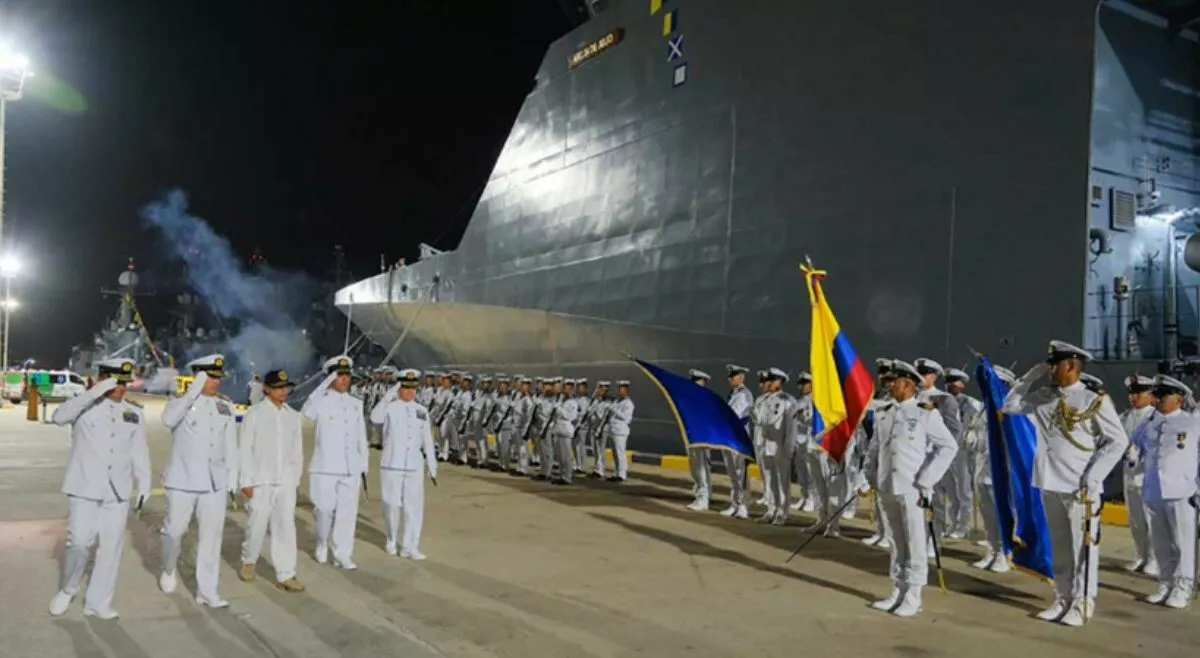
Colombia christened the ARC “24 de Julio” on March 27, 2026, at the ARC Bolivar Naval Base in Cartagena, formally commissioning the largest and most complex warship ever designed and built in the country; the 93-meter ocean patrol vessel, officially delivered to the Colombian Navy on January 31, 2026, after nearly three years of domestic construction, marks a milestone in naval engineering more than a decade in the making.
President Gustavo Petro, who led the ceremony alongside minister of defense Pedro Sanchez and Admiral Juan Ricardo Rozo, commander of the navy, described the ship as “the largest vessel made in the country and 100% designed by Colombian engineers,” acknowledging that some components were imported due to technological gaps, but framing that limitation as a starting point rather than a ceiling for domestic industrial ambition.
A decade of engineering at the Mamonal shipyards
Colombia built the vessel at COTECMAR’s facility in Cartagena’s Mamonal industrial zone, a 186,000-square-meter complex housing 11 docks and a synchronous lift system. The project demanded approximately 90,000 hours of engineering and generated 3,342 direct and indirect jobs, making the ARC “24 de Julio” both a defense landmark and one of the most consequential industrial employment programs the city has seen in recent years.
The ship measures 93 meters in length, 14 meters in beam, and 3.9 meters in draft, with a displacement exceeding 2,460 tons; its hybrid propulsion system reaches speeds of up to 20 knots and sustains operations for up to 40 days across a range of nearly 10,000 nautical miles, covering both Colombia’s Caribbean and Pacific maritime zones under a single hull.
Beyond its dimensions, the ARC “24 de Julio” integrates an Oto Melara 76mm cannon, a 25mm remote weapon station, two 12.7mm machine gun mounts, a flight deck and hangar for helicopters up to 11 tons, and drone operation platforms. Fast-deployment interceptor boats extend its reach for interdiction, surveillance, and search-and-rescue missions, with a base crew of 64 expandable to 109 personnel depending on the assigned operation.
The name connects the vessel to July 24, 1823, when Admiral José Padilla led the Battle of Lake Maracaibo and broke Spanish naval control over South American waters in one of the most decisive engagements of the independence era; naming the most advanced domestically built warship after that date ties Colombia’s modern engineering capacity to the foundational naval moment that helped consolidate the republic.
El buque más grande construido en Colombia se destinará para el fortalecimiento de la lucha contra el narcotráfico.
— Gustavo Petro (@petrogustavo) March 29, 2026
Es totalmente diseñado y construido por ingenieros colombianos.
El ARC 24 de Julio fecha que rememora la gran batalla marina de la independencia nacional en 1823… pic.twitter.com/OtqQT9S6jd
Defense capacity and the humanitarian fleet
The ARC “24 de Julio” is not Colombia’s only recent naval milestone from Mamonal; in March 2026, Colombia also deployed the ARC Benkos Bioho, a 39-meter hospital vessel from the same shipyard, designed to deliver primary health care, telemedicine, and dental services to more than 150,000 people across 22 coastal municipalities in Chocó, Valle del Cauca, Cauca, and Nariño along the Pacific coast.
Together, the two vessels show the full range of what Colombia now builds domestically: One to assert sovereignty across 928,000 square kilometers of maritime territory, the other to close the health access gap that geography has imposed on Pacific communities for decades. Both emerged from the same industrial complex, the same engineering workforce, and the same institutional framework that Colombia has been consolidating at Mamonal since COTECMAR’s founding.
Colombia’s industrial ambition beyond PF2030
President Petro used the March 27 ceremony to argue for expanding domestic defense manufacturing beyond vessels, calling for Colombia to produce drones, anti-drones, and aircraft, and pointing to Brazil’s Gripen combat jets alongside the United States, Germany, and Japan as models of strategic self-sufficiency; he insisted that technological dependency is a vulnerability the country can no longer ignore, given the engineering base it has already built.
Worth noting, the ARC “24 de Julio” operates within Colombia’s PF2030 naval modernization plan, and COTECMAR has already announced “El Retador” as the next vessel in the shipbuilding pipeline; this will be a test of whether the industrial momentum from a decade of domestic production at Mamonal can scale toward the broader defense manufacturing ambition, from patrol vessels to aerial platforms, that President Petro committed to publicly in Cartagena.