

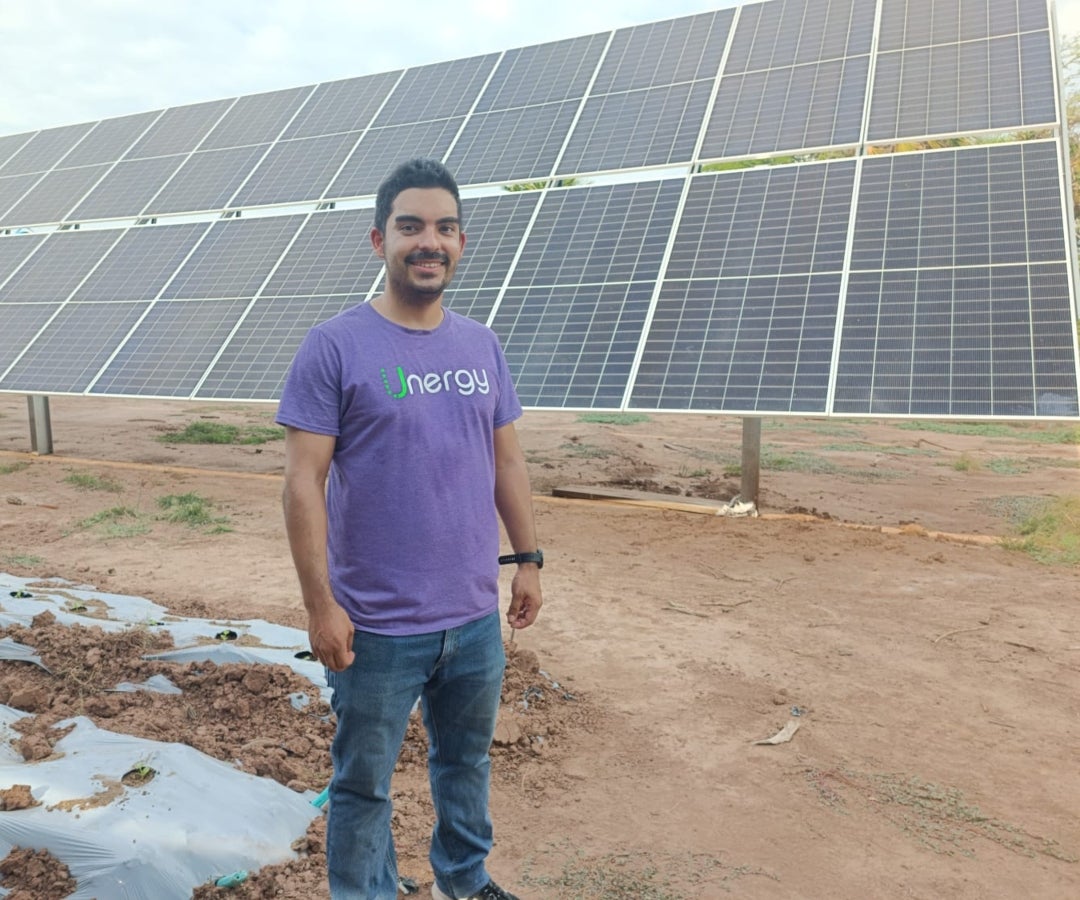
Unergy, a Colombian clean energy startup led by co-founder and chief executive Eduardo Ospina, activated the first regulated energy community in the country under Resolución CREG 101 072 de 2025, partnering with Empresas Públicas de Medellín (EPM) to distribute solar surplus from its own Laureles office rooftop directly to neighboring residential users, making it the first time a group of residential Colombians completed the full regulatory cycle for collective solar generation under the new framework.
The milestone carries weight beyond one Medellin neighborhood because it demonstrates, for the first time in practice, that the regulatory structure Colombia’s energy regulator approved in April 2025 can actually function end-to-end: from panel installation to smart meter delivery to bill discount, without the residential user investing a single peso or owning a square meter of roof.
How the Laureles model works and why it is new
Unergy’s Laureles community operates on a straightforward logic: the company’s office panels generate an average of 1,150 kilowatt-hours per month, feed the surplus into EPM’s local distribution grid, and EPM routes the corresponding credit to registered neighbors’ electricity bills through a collective figure called Autogenerador Colectivo (a legally recognized group of users that jointly generates and shares renewable energy); participating households see a bill reduction without any upfront cost, while Unergy manages and replaces their smart meters at no charge and provides a mobile app for real-time consumption monitoring.
What distinguishes this pilot is not just the savings but the level of digital integration it brings to residential users who would not otherwise access it; in Colombia, low user engagement with energy consumption data has historically slowed the adoption of efficiency measures, and the Laureles model embeds that tracking directly into the community structure rather than leaving it as an optional add-on; EPM, activating its own first regulated energy community as a grid operator through this partnership, generated institutional learning that Colombia’s other 31 grid operators can now reference.
Colombia’s regulatory moment and the infrastructure behind it
The Laureles activation sits inside a broader regulatory shift that Colombia took years to complete; Resolución CREG 101 072 de 2025, which the Comisión de Regulación de Energia y Gas (CREG) approved on April 7, 2025, formally integrated energy communities into the National Energy System for the first time and targets at least one additional gigawatt (GW) of non-conventional renewable capacity, with the potential to reach 500,000 families nationwide according to the Ministry of Mines and Energy.
Colombia currently operates approximately 1,600 MW of solar capacity and more than 3,000 MW of total non-conventional renewable installed capacity, representing over 10% of the national electricity matrix according to the Unidad de Planeación Minero Energética (UPME).
Installed renewable capacity multiplied 15-fold since 2018, yet no energy community had completed the full implementation cycle under the new resolution before Unergy and EPM did so in Laureles; Europe, by contrast, has more than 1,900 active energy communities with 1.2 million participants, and Brazil enabled shared generation in 2012, building a market now valued at approximately US$500 billion in this model.
The Grid Bottleneck and Solenium’s Infrastructure Response
Even so, entrenched obstacles in the market keep projects from scaling in ways that regulation alone cannot resolve, and the operational gap that separates the model’s promise from its national rollout comes down to a single constraint Ospina identifies plainly: securing a grid connection point from the local electricity operator can take months or years, a bottleneck that neither capital nor regulatory clarity eliminates on its own.
Solenium, Ospina’s second company, tackles the physical infrastructure side of the same challenge by building and operating solar mini-farms of 1.5 to 5 MW connected to local distribution grids, currently with over 10 MW in operation, 20 MW under construction across more than 10 departments, and a US$100 million international debt facility in process, backed by the FMO (the Dutch development bank).
Combined with Unergy’s US$4.5 million equity round and an US$80 million co-investment commitment (of which US$25 million is already deploying), total projected capital deployment for both companies reaches between US$180 and US$200 million, all directed at the same target: 100 mini-farms, 100,000 connected users, and the practical proof that solar for everyone in Colombia is an operational proposition rather than a regulatory aspiration.