

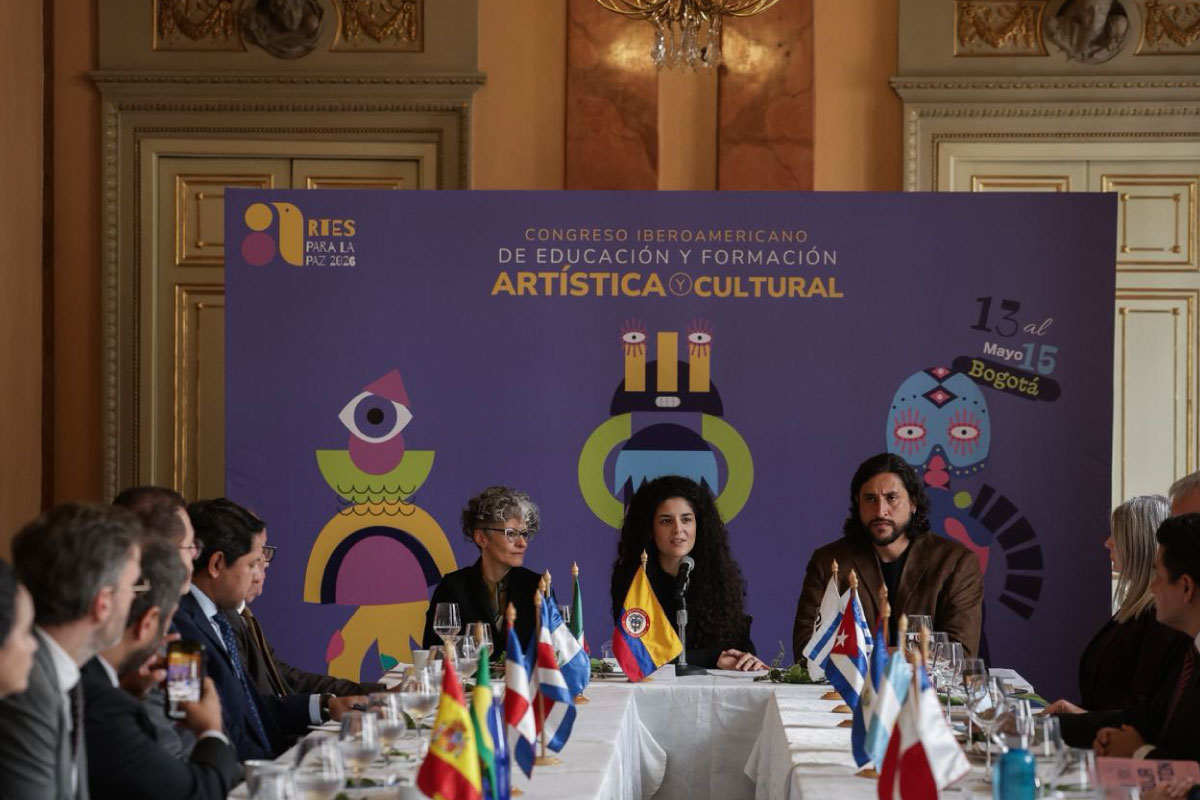
Colombia has been confirmed as the host country for the Ibero-American Congress on Artistic and Cultural Education and Training “Arts for Peace 2026,” one of the region’s most important gatherings focused on culture, pedagogy, and integration. The event will take place from May 13 to 15, 2026, at the Delia Zapata Olivella National Center for the Arts in Bogotá, bringing together ministers, specialists, educators, cultural managers, and artists from more than 20 Ibero-American countries.
The designation represents international recognition of the role Colombia has played in promoting public policies focused on access to culture and on artistic education as a tool for social transformation. Over three days, the Colombian capital will become the setting for strategic debates, the exchange of experiences, and the development of agreements aimed at strengthening the cultural sector.
The congress will be organized by Colombia’s Ministry of Cultures, Arts and Knowledge and the Organization of Ibero-American States (OEI), with the support of multilateral institutions such as UNESCO, the Ibero-American General Secretariat (SEGIB), and the Development Bank of Latin America and the Caribbean (CAF).
Colombia will be the epicenter of Ibero-American Cultural dialogue for Arts for Peace 2026
The event’s agenda includes keynote conferences, specialized panels, workshops, and multilateral dialogue spaces focused on the role of art within contemporary educational systems. One of the main goals will be to strengthen artistic education as a civic right and as a global public good with a direct impact on the quality of life of communities.
Organizers also aim for the discussions to go beyond the academic sphere and translate into concrete actions. Among the priorities is the design of joint strategies to strengthen school curricula, promote teacher training, expand cultural access, and encourage new teaching methods based on creativity, sensitivity, and critical thinking.
The participation of countries such as Spain, Portugal, Mexico, Argentina, Chile, Peru, Brazil, and Colombia, among others, will allow for the comparison of successful models and the creation of a regional roadmap on how to integrate the arts into educational processes from an early age.
Colombia arrives with progress in artistic education and peacebuilding
The selection of Colombia as host coincides with a period of domestic progress in this area. One of the main references is the Arts for Peace program, an initiative that has benefited more than 538,000 people in 726 municipalities through cultural processes focused on coexistence, memory, and social inclusion.
This is complemented by the implementation of the Arts in the Classroom Law, approved in 2025, which strengthened the incorporation of artistic education within the Colombian school system. The legislation seeks to guarantee permanent spaces for disciplines such as music, dance, theater, literature, and visual arts within academic training.
These developments position Colombia as a regional laboratory for cultural policies linked to human development, which is why the congress will also serve as a platform to showcase local experiences with the potential to be replicated in other countries.