

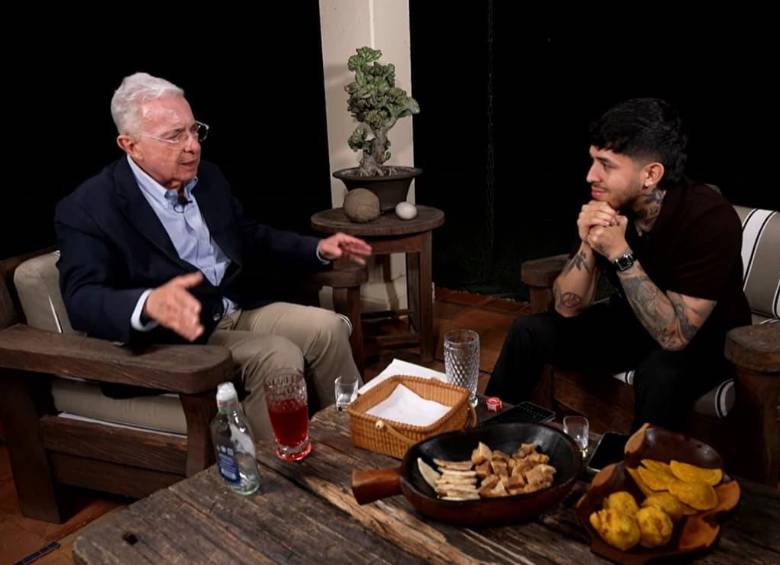
Colombian streamer Westcol, whose real name is Luis Villa and whose social media channels reach millions of followers across platforms, reported on May 9, 2026, that his Instagram account was hacked hours before his scheduled livestream interview with former president Alvaro Uribe Velez, and he immediately questioned whether the timing was a coincidence, given the political weight of the broadcast.
The interview went ahead on May 10 via the Kick platform, drawing more than 500,000 simultaneous viewers and immediately trending across Colombian social media.
The episode placed the intersection of screen and politics at the center of Colombia’s digital conversation for the second time in weeks, as the incident arrived after Westcol had already conducted a highly visible livestream with President Gustavo Petro that drew millions of viewers and established him as an unusual bridge between the country’s largest online youth audience and its formal political class.
The hack, the statement, and the absence of proof
Westcol announced the breach through his remaining active accounts, writing that the attack occurred “just before that little stream” in reference to the Uribe interview and adding that his account was “in the process of recovery,” a phrasing that confirmed temporary loss of access without specifying the nature of the intrusion.
He stopped short of naming a direct perpetrator in his initial posts, though the title of a YouTube video he uploaded shortly after suggested that “a very powerful government person” was responsible, a phrase that circulated rapidly across Colombian social media and amplified the political interpretation of the event.
However, as of May 10, 2026, no cybersecurity authority had opened a formal investigation, no technical evidence had entered the public record confirming the origin or method of the breach, and neither the national government nor any official had acknowledged any connection; Semana noted explicitly that “no public evidence confirms the origin of the incident.”
That gap between the allegation and its evidence base matters, because in Colombia’s polarized pre-election environment, an unverified accusation of state-level digital sabotage carries immediate political consequences regardless of its factual standing.
Three hours at El Uberrimo: politics, history, and a pony
The interview took place on May 10 at Uribe’s hacienda El Uberrimo in Monteria and covered the most contested chapters of his presidency, beginning with the falsos positivos, the extrajudicial executions in which members of the Colombian Army killed civilians and presented them as combatants killed in action to inflate operational results; the Jurisdiccion Especial para la Paz (JEP, the transitional justice tribunal created after the 2016 peace agreement with FARC) has documented 7,837 victims of this practice.
Uribe acknowledged the killings occurred but rejected that his government promoted them: “We never incentivized crimes, nor did anyone receive rewards for crimes within the armed forces,” he said, calling accusations against him “defamation.”
The interview also addressed the nickname “paraco,” a colloquial term for paramilitaries tied to extreme-right violence, which critics have long applied to Uribe; he rejected the association and argued that his security policy combated both guerrillas and paramilitarism simultaneously.
Among the most shared clips was his rebuttal of President Petro’s claim about who reduced Colombia’s working hours: When Westcol relayed Petro’s version, Uribe replied without hesitation, “He didn’t tell you the truth; he lied.”
The final stretch turned personal. Westcol told Uribe that the Familias en Accion social program, expanded under his government, changed his family’s life: “If Familias en Accion had not existed, maybe I wouldn’t be here. Thanks to Familias en Accion, I was able to buy shoes to go to work.”
Uribe, visibly moved, walked the streamer through the hacienda, showed him works by Antioquia artist Debora Arango and sculptor Javier Giraldo, and offered a newborn pony for a charity raffle among Westcol’s followers: “If you raffle it among all the people who follow you for a social cause of your choosing, I’ll give it to you.”
What the episode signals for Colombia’s digital-political space
The truth is, the Westcol hack, verified or not in its origins, illustrates a structural vulnerability that Colombia’s political-digital environment now faces as the 2026 presidential campaign accelerates.
Content creators who attract politicians to their platforms inherit the political risks those politicians carry, including adversaries willing to disrupt a broadcast through whatever means available, and Colombia has no institutional framework yet for investigating or deterring digital interference with civilian media figures who operate outside traditional press protections.
Colombia’s cybersecurity institutions, principally the Centro Cibernetico Policial and the Ministerio de Tecnologias de la Informacion y las Comunicaciones (MinTic), now face a credibility question: Whether a high-profile account breach with obvious political timing receives serious institutional attention, or whether it fades once the livestream airs, leaving the screen-and-politics intersection as unprotected after the incident as it was before.